There is a particular kind of silence that exists only inside old forests. Not the absence of sound — birds move through the canopy above Takijiri-oji, water runs somewhere below the stone path, a single temple bell carries from the valley — but a quality of atmosphere that slows the body down before the mind has caught up. The Kumano Kodo does not announce itself. It simply begins: a worn stone staircase rising into cedar, a small red torii gate marking where ordinary ground ends and something older starts, and then three hours of walking during which the modern world becomes genuinely difficult to remember.
01The Route
The Kumano Kodo is a network of ancient pilgrimage routes crossing the mountainous Kii Peninsula in Wakayama Prefecture, roughly three hours south of Osaka by train. The routes have been walked continuously for over a thousand years — by emperors, monks, merchants, and, in more recent centuries, by travelers with no particular religious attachment but a quiet sense that something here is worth the journey. In 2004, the Kumano Kodo was designated a UNESCO World Heritage Site, one of only two pilgrimage routes in the world to hold that status.
For a first visit, the Nakahechi route — the Imperial Route — is the correct choice. It runs approximately 70 kilometers from the trailhead at Takijiri-oji to the grand shrine at Nachi, passing through forested ridges, small farming villages, and a series of oji shrines that mark significant points along the original pilgrimage. The full route is comfortably completed in five days at a beginner's pace, with overnight stays in traditional minshuku guesthouses along the way.
The recommended five-day structure:
- Day 1 — Arrive in Osaka or Kyoto. Train to Kii-Tanabe. Transfer to Takijiri-oji. Walk Takijiri-oji to Chikatsuyu-oji (15km).
- Day 2 — Chikatsuyu-oji to Nonaka (12km). Detour to Tsuboyu Onsen at Yunomine.
- Day 3 — Nonaka to Kumano Hongu Taisha (13km). Afternoon at the grand shrine.
- Day 4 — Bus to Shingu. Walk to Kumano Hayatama Taisha. Coastal path to Nachi.
- Day 5 — Kumano Nachi Taisha and Nachi Falls. Return to Osaka.
Book accommodation in advance. Several sections of the Nakahechi route have very limited overnight options, and the minshuku closest to the trailhead fills weeks ahead during the peak spring season. The Kumano Travel booking service handles English-language reservations for the majority of route guesthouses.
02Getting There
The logistics of reaching the Kumano Kodo are slightly more involved than the walking itself. From Osaka (Shin-Osaka), take the JR Kuroshio Limited Express directly to Kii-Tanabe station — a journey of approximately two hours and fifteen minutes. A Japan Rail Pass covers this route and is worth purchasing before departure if the wider Japan itinerary includes any bullet train travel. From Kii-Tanabe, a local bus runs to Takijiri-oji and takes around 30 minutes.
Purchase the Japan Rail Pass before leaving your home country. It cannot be bought inside Japan, and the price difference is significant. The pass covers the full Kuroshio Express route from Osaka to Kii-Tanabe and eliminates every intercity ticketing decision for the duration of the route.
Arrive in Kii-Tanabe the evening before the first walking day. The small town has enough restaurants and accommodation to make for a comfortable settling-in night, and starting the trail with a full sleep rather than a travel-day deficit is the single most useful piece of logistics advice for this particular route.
03Forest Entry
The trailhead at Takijiri-oji announces itself with a sudden shift in the air. The bus drops passengers at a small car park beside the Hiki River, and the trail begins almost immediately — a staircase of worn stone rising steeply into cedar forest that closes behind you within the first ten minutes. The light inside the forest is filtered and green. The sound of the river drops away. The cedar trunks rise to a height that makes ordinary trees feel modest. Pilgrims have stood at this point, at this specific staircase, for a thousand years.
The first day covers 15 kilometers from Takijiri-oji to the village of Chikatsuyu-oji, a long but gentle introduction to the route's rhythm. The terrain alternates between forested ridge paths and short descents into small valleys where tea fields and vegetable plots appear between the trees. The path is well-marked throughout, with bilingual Japanese-English signage at all major junctions, and the gradient is manageable for walkers of any experience level.
Spring in this section means cherry blossom in the lower valleys in late March and early April, replaced by fresh cedar growth and wild flower patches as the season progresses toward May. The forest floor stays damp regardless of recent rainfall. Waterproof footwear is strongly recommended. Leeches are present on the lower sections after rain — not dangerous, but startling if unexpected.
Sections of the Nakahechi route have no mobile signal for extended stretches, particularly between Takijiri-oji and Chikatsuyu-oji. Download offline maps via maps.me or Gaia GPS before the first day, and carry a printed copy of the official Kumano Kodo trail map as a backup.
04Nights on the Route
Accommodation on the Kumano Kodo is almost entirely in minshuku — small family-run guesthouses that function somewhere between a bed-and-breakfast and a private home. Rooms are typically traditional: tatami mat flooring, futon bedding laid out each evening, and a shared bathroom with a deep Japanese soaking tub. Dinner and breakfast are generally included in the room rate, and both tend to be exceptional — miso soup, grilled river fish, pickled mountain vegetables, and rice served with the quiet formality of someone who has been cooking this meal for forty years.
This is where the Altitude Merino Base Layer and TrailWash Toiletry Bag earn their weight. Five consecutive days of walking in a humid forest climate — morning damp, afternoon heat, evening cool — requires a base layer that manages temperature shifts without becoming uncomfortable, and a toiletry organization that works efficiently in a small shared bathroom without requiring the entire bag to be emptied on the tatami floor. Japanese minshuku etiquette rewards compact, organized guests. Spreading gear across a traditional room is more socially noticeable than it would be elsewhere.
Minshuku Etiquette
A few practical notes that will make every night on the route easier:
- Remove shoes at the entrance (genkan) and wear the provided slippers indoors. Do not wear slippers into the tatami sleeping room.
- Dinner is served at a fixed time — usually 6:00 or 6:30 pm. Arriving late is considered impolite.
- The shared bathroom has a strict order: shower first, then enter the communal soaking tub. The water is shared and is not changed between guests.
- Breakfast is early — typically 7:00 am — timed around the walking day. Meal times are not flexible.
- Quiet hours begin around 9:30 pm. The minshuku hosts are generally asleep by 10:00.
Book through Kumano Travel or directly through the individual guesthouses listed on the official Nakahechi accommodation page.
05Day Two: Yunomine Detour
The second day's route passes near Yunomine Onsen, one of the oldest hot spring villages in Japan and, remarkably, a UNESCO World Heritage Site in its own right — the only onsen in Japan to hold that distinction. The springs at Yunomine have been used continuously for over 1,800 years, and the small riverside village that has grown around them retains a quality of stillness that feels genuinely ancient. Wooden bathhouses overhang the river. The water steams even in the afternoon warmth. The whole place smells faintly of sulfur and cedar smoke.
Tsuboyu Onsen — a single-person stone bathing tub set directly in the river, bookable by the hour — is the correct detour here. It requires a short walk from the main path and a reservation made at the Yunomine tourist counter earlier in the day. Arrive in Yunomine by 1:00 pm, reserve a slot, walk the remaining section to Nonaka while the slot opens, and return for the bath before dinner. The water runs at approximately 42°C, and the sitting position inside the tub requires a modest degree of flexibility.
The DryPeak Trek Towel is the piece of gear this detour specifically requires. Japanese bathing culture does not provide towels at most small onsen facilities, and arriving at Tsuboyu without one means bathing and then attempting to dry off with a spare shirt in a stone tub barely large enough to sit upright in. The microfiber construction packs flat into the TrailEase Daypack side pocket without adding meaningful weight to the daily carry.
Yunomine village has a small shop selling locally made onsen-cooked eggs (onsen tamago), boiled in the thermal springs. Buy two. They are one of the stranger and more memorable snacks available on this route.
06Kumano Hongu Taisha
The third day ends at Kumano Hongu Taisha, the most sacred of the three Kumano Grand Shrines and the spiritual center of the entire pilgrimage network. The approach through forested ridgeline on the final kilometers before the shrine is intentionally gradual — the path narrows, the cedar grows taller, the sound of the valley drops away — and arrival at the main torii gate at the top of the stone staircase carries a weight that does not depend on any particular religious belief. Pilgrims have been arriving at this specific point, from this specific direction, for over a millennium.
The shrine complex itself is compact but imposing, centered on a main hall (honden) rebuilt in 1889 after flood damage destroyed the original riverside location. The famous Ōtorii gate — one of the largest torii in Japan, standing 33.9 meters tall — marks the original shrine site at Oyunohara, a 10-minute walk downhill from the current complex. It is worth the walk. The scale of the gate against the surrounding forest is one of the more unusual visual experiences on the route.
Spend the afternoon at the shrine, buy an omamori protective charm at the main hall, eat lunch at one of the small stalls near the approach path, and sleep in Hongu village with a sense that the logistics of the following two days require very little effort by comparison. The hard walking is behind you.
07Nachi Falls
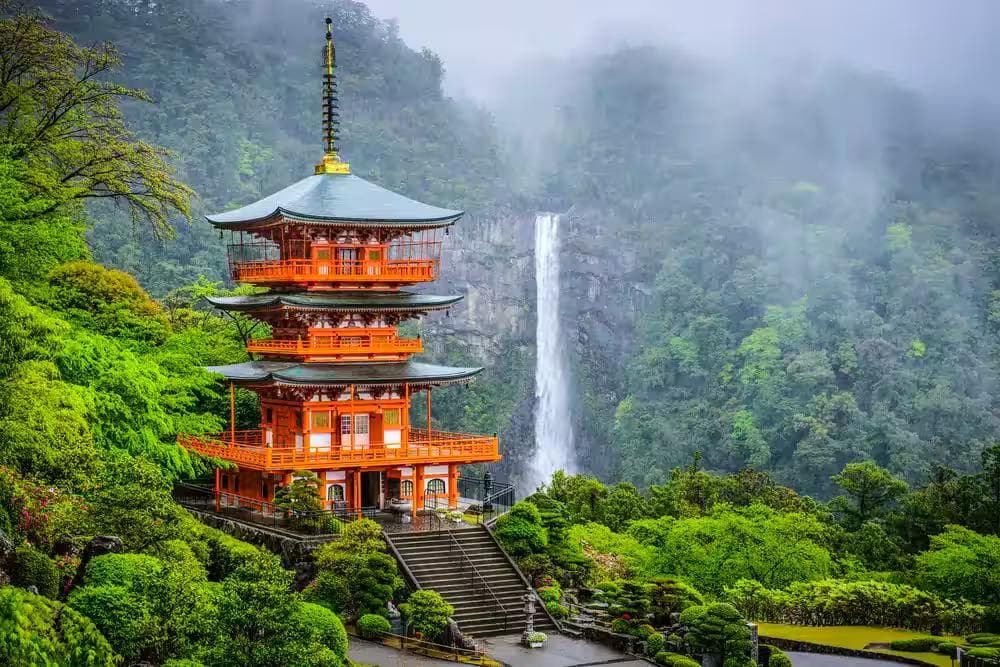
The fifth and final day is built around Kumano Nachi Taisha and the Nachi Waterfall — at 133 meters, the tallest uninterrupted waterfall in Japan, and the reason this particular arm of the route terminates where it does. The approach from the coastal town of Nachi-Katsuura climbs through forest before the shrine complex comes into view through the trees, red pagoda and white waterfall occupying the same frame in a composition that appears on virtually every piece of Kumano Kodo photography for good reason.
The waterfall can be heard before it can be seen. A low, continuous thunder that builds through the final 15 minutes of forest path before the viewpoint opens abruptly onto the full cascade. The mist from the falls reaches 50 meters into the surrounding air, and the rocks at the viewpoint platform are permanently damp. In spring, the surrounding maple and cherry canopy frames the falls in a way that photographers position themselves for and rarely manage to fully capture.
The return to Osaka from Nachi-Katsuura takes approximately three hours by limited express, with a change at Shingu. The Kuroshio Limited Express runs several services throughout the afternoon and evening and is covered by the Japan Rail Pass.
Allow a full morning at Nachi before beginning the return journey. The shrine complex, waterfall viewpoint, and small attached museum take two to three hours to do properly, and rushing the final day of a five-day pilgrimage to catch an earlier train is a decision most people regret.
08Carrying Five Days Right
Five days of trekking in a humid forest climate with overnight stays in traditional guesthouses is not an expedition, but it is also not a weekend trip. The packing decision that matters most is the one made at home, before the bag is closed.
The TrailEase Daypack (22L) works as both a carry-on and a daily walking pack for this route — large enough to hold the day's needs comfortably, compact enough for the small genkan entrance of a minshuku without occupying the entire tatami floor. What goes inside it each morning:
- Altitude Merino Base Layer (spare, compressed) — for temperature shifts between humid forest afternoon and cool evening air
- DryPeak Trek Towel — for onsen stops, surprise rain, and the general dampness of a cedar forest in spring
- TrailWash Toiletry Bag — organized and accessible without unpacking everything at a shared bathroom sink
- Rain cover or waterproof liner — the forest does not warn before it rains
Checked luggage forwarding (takuhaibin) is available between major towns on the Nakahechi route through services like Yamato Transport. For a price of around ¥1,500–2,000 per bag per transfer, your main luggage travels ahead to the next minshuku while you walk with only the day's essentials. For five days in a humid climate with a full pack, this service is not a luxury. It is the difference between an enjoyable trek and an exhausting one.

Altitude Merino Base Layer
Lightweight warmth and moisture regulation during cool spring mornings

DryPeak Trek Towel
Comfort and moisture management during humid forest conditions

TrailWash Toiletry Bag
Keeps five days of toiletries organized for efficient use in shared minshuku bathrooms

TrailEase Daypack 22
Carries the day's essentials across routes that average 12–15 kilometers daily, compact enough to fit inside a minshuku entrance